
Trying something new can be uncomfortable.
Whether it’s learning a new skill, striking up a conversation with someone you don’t know, or changing a long-held habit, stepping into unfamiliar territory always comes with uncertainty. There are no guarantees. Things might not work out exactly as planned. There may be setbacks, surprises, and lessons learned along the way.
But there’s another truth, too: growth rarely happens without a willingness to experiment.
The same is true in agriculture.
Every farming practice we now consider commonplace was once an idea someone was willing to test. No-till farming, cover crops, rotational grazing—each began with farmers asking “What if?” and being willing to try something different, despite the risks.
This year, Fields of Sinsinawa is following that spirit of curiosity into the wild world of relay cropping.
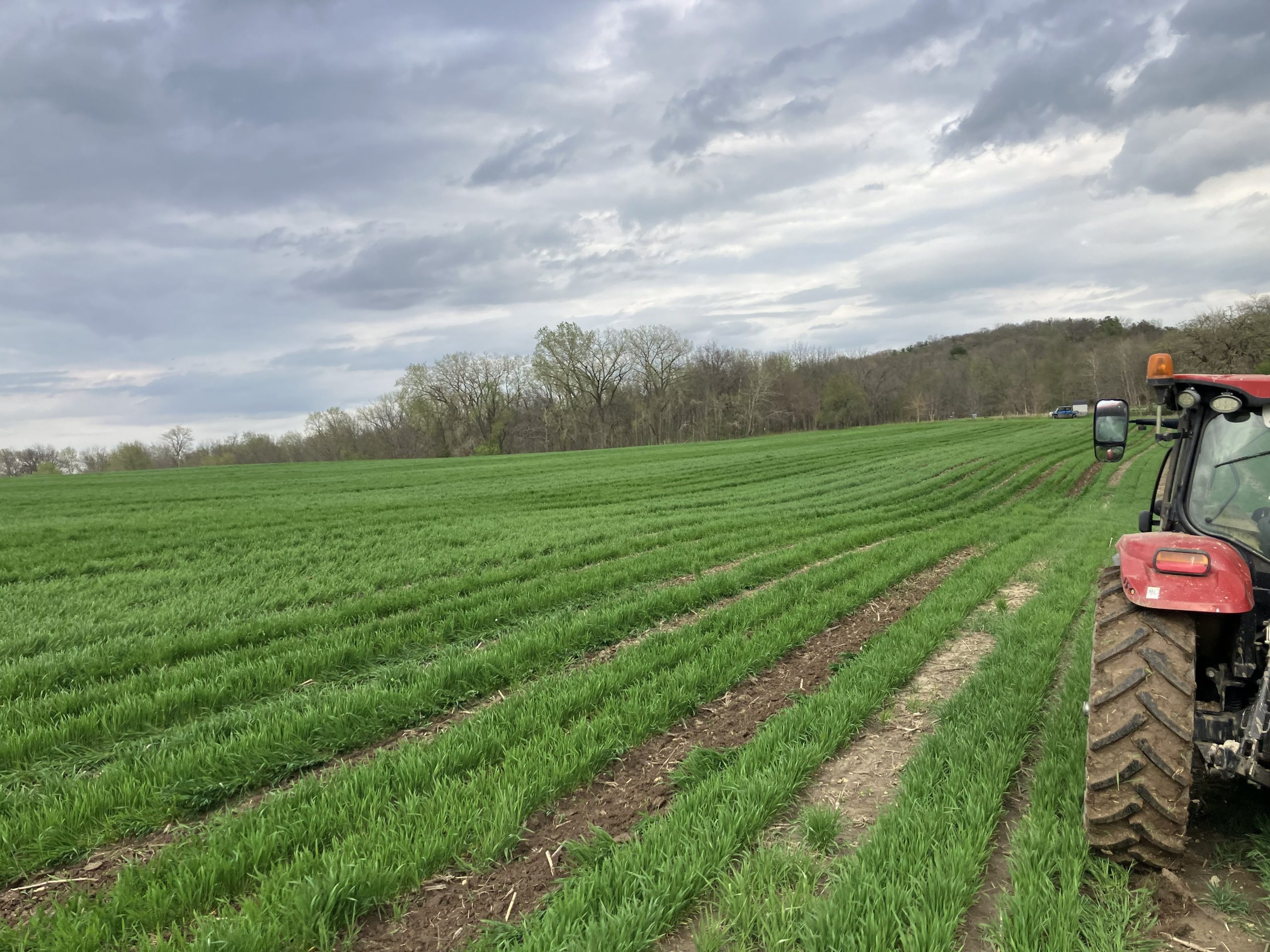
Relay cropping is exactly what it sounds like: passing the baton from one crop to the next. In this case, soybeans were planted into a standing crop of winter wheat before the wheat is harvested, creating a period where both crops are growing together in the same field. The goal is to keep living roots in the soil longer, make better use of the growing season, and potentially harvest two crops from the same field in a single year.
It’s an approach that sparks plenty of questions.
Will the soybeans get enough sunlight beneath the wheat canopy? How will the crops compete—or cooperate? What happens below ground when two different root systems are active at the same time? Seeing as we’re in an organic system, will the weeds overtake everything?
The honest answer is that we’re still learning.
That’s part of what makes this project so exciting.
The field we’ll visit during our upcoming field day has already had quite a journey. Last summer, it hosted our Stock Cropper multi-species livestock barn, where animals contributed their own unique impact to the landscape. Following the grazing season, winter wheat was seeded along with a highly diverse cover crop mix. The cover crop winter-killed, but not before contributing root diversity, biological activity, and organic matter to the system.
In many ways, the field was biologically primed for experimentation.
This spring, soybeans were planted directly into the standing wheat, setting the stage for our first relay cropping trial.
As with any experiment, success isn’t guaranteed.
In fact, the farmer managing the project offered perhaps the healthiest perspective possible when he said:
“The beans might not turn out all that great. But the wheat is looking like one of the best wheat crops we’ve ever raised, so even if we don’t get any beans, it was worth it.”
There’s wisdom in that statement.
Too often, we measure success only by whether an experiment achieves its intended outcome. But innovation doesn’t work that way. Sometimes the greatest value comes from what we learn along the journey. Sometimes one unexpected success outweighs another disappointment. And sometimes the simple act of trying something new opens doors we never knew existed.
That’s true on the farm, and it’s true in life.
The future of agriculture won’t be built by people who never take risks. It will be shaped by curious people willing to observe, ask questions, share what they learn, and occasionally venture beyond their comfort zones.
That’s why we’re inviting you to join us to our field day on June 5.
Come walk the field. See the relay cropping system for yourself. Ask questions. Share your observations. Learn alongside fellow farmers, landowners, and curious community members who are interested in what happens when we try something different.
The field day will be this coming Friday, June 5, 2026 at 5-6:30 pm. We’ll meet at the Sinsinawa Maintenance Shed, 2551 County Rd. Z, Hazel Green, WI, load up on people movers, and go check out the field. Afterward, we’ll return to the shed for free burgers and camaraderie. The event is FREE and ALL ARE WELCOME!
Before attending, be sure to watch our April 28 video documenting the soybean planting into standing winter wheat. Then come see how the story is unfolding in real time.
Welcome to the wild world of relay cropping. We can’t wait to explore it with you.


